
jestin joseph
Founder
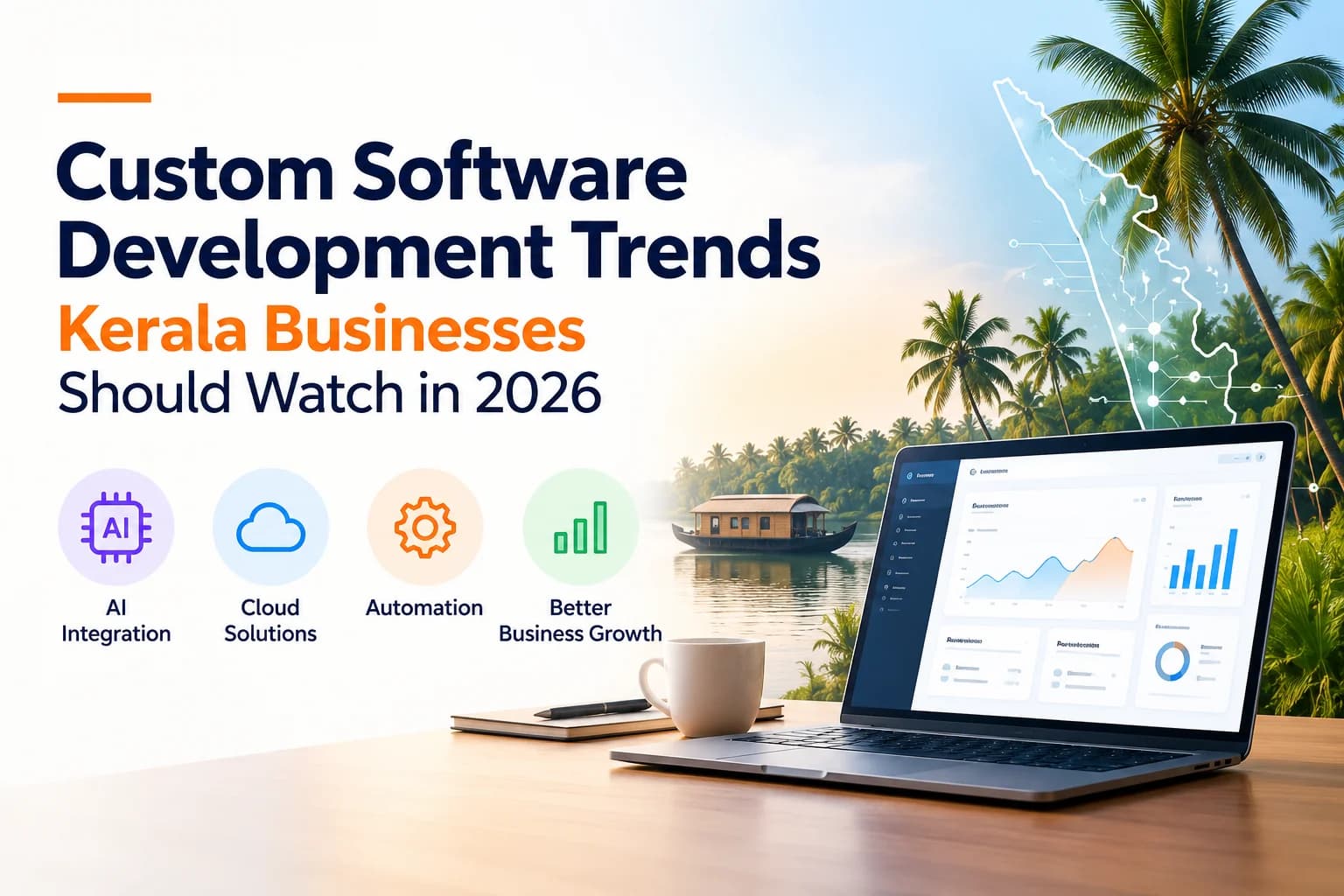
Technology is changing how businesses operate, serve customers, and compete. For many Kerala businesses, digital transformation is no longer limited to launching a website or moving from paper records to spreadsheets. Companies are now exploring custom software, automation, cloud platforms, analytics, ecommerce systems, and artificial intelligence to improve daily operations and support growth.
Kerala’s 2026 IT policy places emphasis on cloud services, 5G, responsible use of data, open-source software, and emerging technologies, as noted in the Kerala Development Report 2026. The Government of India has also highlighted AI transformation and the need for businesses and technology professionals to build stronger AI capabilities.
For business owners, the important question is not simply, “Which technology is trending?” The better question is: “How can technology solve a real business problem and create measurable value?”
What is custom software development?
Custom software development means creating a digital solution around the specific requirements of a business. Instead of changing your entire workflow to fit a generic application, custom software can be designed around:
- Your business processes
- Your employees and user roles
- Your customers
- Your products and services
- Your reporting requirements
- Your existing software
- Your future growth plans
Custom software may include a CRM system, ERP platform, customer portal, ecommerce application, booking system, business dashboard, workflow automation platform, or industry-specific product.
Why are Kerala businesses investing in custom software?
Many businesses begin with spreadsheets, separate applications, manual approvals, and disconnected data. These tools can work during the early stages, but they may create problems as the business grows. Common challenges include:
- Repetitive manual work
- Duplicate data entry
- Delayed customer follow-ups
- Poor visibility across departments
- Difficulty tracking orders or enquiries
- Limited reporting
- Disconnected business systems
- Inconsistent customer service
- Difficulty managing multiple branches
Custom software can bring important processes into one connected platform. It can help teams reduce manual work, improve access to information, and make decisions using more reliable business data.
Important custom software development trends in 2026
1. AI-assisted business applications
Artificial intelligence is becoming part of business software, not just a separate experimental tool. Businesses are exploring AI for:
- Customer support assistants
- Automated document processing
- Sales enquiry classification
- Business recommendations
- Report generation
- Internal knowledge search
- Demand forecasting
- Workflow automation
AI-native development platforms and AI-enabled software development are among the technology trends highlighted for 2026 in Gartner’s Top Strategic Technology Trends for 2026. However, AI features should be introduced carefully, with attention to data quality, privacy, security, and human review.
For example, a business application could automatically organize incoming enquiries, identify urgent requests, and send them to the correct team. The goal is not to replace every human decision. The goal is to help employees spend less time on repetitive tasks.
2. Cloud-based software
Cloud-based software allows authorized users to access applications and data through the internet. This can be useful for Kerala businesses with:
- Multiple branches
- Remote teams
- Field staff
- Distributed operations
- Customers in different locations
- Employees who need mobile access
Cloud software can also make it easier to expand storage, support additional users, and connect with other online services. Kerala’s technology policy specifically recognizes cloud-based services as part of the state’s digital transformation direction.
However, moving to the cloud does not automatically make a system secure or efficient. Access controls, backups, monitoring, data protection, and proper architecture are still essential.
3. Business automation
Automation helps software complete predictable tasks with less manual involvement. Examples include:
- Sending automatic order notifications
- Assigning leads to sales staff
- Generating invoices
- Updating stock levels
- Sending appointment reminders
- Creating approval workflows
- Producing regular reports
- Synchronizing data between applications
Automation is especially valuable when employees repeatedly perform the same process every day. Before automating a workflow, businesses should first understand how the process currently works. Automating a poorly designed process may only make the problem happen faster.
4. Connected business systems
Many businesses use separate tools for sales, accounting, inventory, customer communication, marketing, and operations. When these systems do not communicate with each other, employees may need to enter the same information multiple times. Custom integrations can connect:
- CRM systems
- ERP platforms
- Payment gateways
- Ecommerce websites
- Inventory management tools
- Accounting software
- Shipping systems
- Communication platforms
- Customer support tools
Connected systems can reduce duplicate work and give teams a clearer view of important business information.
5. Stronger cybersecurity and software governance
As businesses adopt more cloud services, AI tools, integrations, and custom applications, security must become part of the development process. Important security practices include:
- Role-based access control
- Secure password management
- Multi-factor authentication
- Regular backups
- Data encryption
- Secure API development
- Application monitoring
- Software updates
- Audit logs
- Employee security awareness
Google Cloud’s Cybersecurity Forecast 2026 continues to highlight AI-related risks, cloud threats, and attacks involving third-party or user-managed software. Security should not be treated as something to add after development. It should be considered during planning, design, development, testing, and ongoing maintenance.
6. Mobile-first business experiences
Customers and employees increasingly use mobile devices to access services, complete tasks, communicate, and review information. A business application may need to support:
- Mobile customer portals
- Field-service applications
- Mobile order management
- Employee dashboards
- Delivery tracking
- Appointment management
- Mobile payments
- Real-time notifications
A mobile-first approach does not always mean building a separate mobile app. In some cases, a responsive web application may be more practical. The right option depends on the user journey, device requirements, offline needs, and business goals.
7. Data dashboards and real-time reporting
Businesses need more than stored data. They need useful information that supports decisions. Custom dashboards can help business owners monitor:
- Sales performance
- Customer enquiries
- Order status
- Inventory levels
- Employee productivity
- Website leads
- Marketing performance
- Financial indicators
- Service response times
A well-designed dashboard should focus on the information that users actually need. Displaying too many charts and numbers can make decision-making more difficult.
How custom software can help different Kerala businesses
Retail and ecommerce businesses
Custom software can help manage products, inventory, orders, customer accounts, payments, delivery, and reporting.
Hospitality businesses
Hotels, restaurants, cafes, and cloud kitchens may benefit from reservation systems, POS integration, order management, customer loyalty features, and operational dashboards.
Education and training organizations
Custom platforms can support student management, online learning, attendance, payments, assessments, communication, and reporting.
Real estate and construction companies
Software can help manage leads, projects, documents, customer communication, property information, and internal workflows.
Healthcare and professional service providers
Custom systems can support appointment management, patient or client records, reminders, billing, and secure communication, subject to applicable legal and privacy requirements.
Manufacturing and distribution companies
Businesses may use custom software for inventory, procurement, sales orders, production tracking, delivery, and supplier management.
When should a business consider custom software?
Custom software may be worth considering when:
- Existing tools do not fit your workflow
- Your team spends too much time on manual tasks
- Important information is stored in multiple places
- You need to connect different systems
- Your business requires a unique process
- Your customers need a dedicated digital experience
- You need reports that existing tools cannot provide
- Your current software cannot support future growth
Custom software may not be necessary for every business. Sometimes an existing platform, integration, or process improvement is enough. A proper requirements review can help identify the most practical approach.
How to start a custom software project
A successful project begins with a clear understanding of the problem. Before development starts, define:
- The business challenge
- The users of the system
- The most important workflows
- The required features
- Existing tools that need integration
- Data and security requirements
- The expected business result
- Features that can be added later
It is often better to start with a focused first version than to build every possible feature at once. A phased approach allows the business to test the solution, collect feedback, and improve it over time.
Choosing the right development partner
When evaluating a custom software development company, consider:
- Experience with similar business problems
- Understanding of your industry
- Ability to explain technical decisions clearly
- Approach to security and data protection
- Quality of project planning
- Testing and deployment practices
- Integration capabilities
- Post-launch support
- Portfolio and relevant case studies
The cheapest initial quote may not always represent the lowest total cost. A poorly planned system can require expensive corrections later. Focus on business value, maintainability, reliability, and long-term support.
Final thoughts
Custom software development is becoming an important part of how businesses improve efficiency and compete in a digital economy. For Kerala businesses, the strongest opportunities are not limited to following every new trend. They come from applying the right technology to real business challenges.
AI, cloud platforms, automation, integrations, mobile experiences, dashboards, and cybersecurity can all provide value when they are connected to a clear business objective. The right starting point is to identify the process that is slowing your business down, understand what your customers and employees need, and plan a solution that can grow with your organization.
Learn more about custom software development
Skillycat helps businesses explore custom software solutions built around their workflows, customers, and growth plans. Learn more about custom CRM, ERP, ecommerce, business automation, dashboards, customer portals, and industry-specific software solutions.